What's Agent Communication Protocol (ACP)? The Language of Intelligent Agents
- Aug 14, 2025
- 3 min read
In the world of AI agents and autonomous systems, communication isn’t just important — it’s the foundation of collaboration. Whether you’re building a swarm of warehouse robots, a suite of intelligent business agents, or a network of AI-driven monitoring systems, these agents need a way to talk, share knowledge, and make decisions together.

That’s where the Agent Communication Protocol (ACP) comes in — a standardized framework that defines how agents understand each other, share intent, and coordinate actions. Much like human languages and grammar rules allow us to exchange ideas clearly, ACP provides a common “language” for digital agents.
What's Agent Communication Protocol (ACP)?
Agent Communication Protocol (ACP) is a set of rules and structures that enable intelligent agents to communicate effectively in distributed, multi-agent environments.
It specifies:
Message formats (how data and intent are structured)
Interaction patterns (how conversations progress between agents)
Semantics (how meaning is preserved and interpreted)
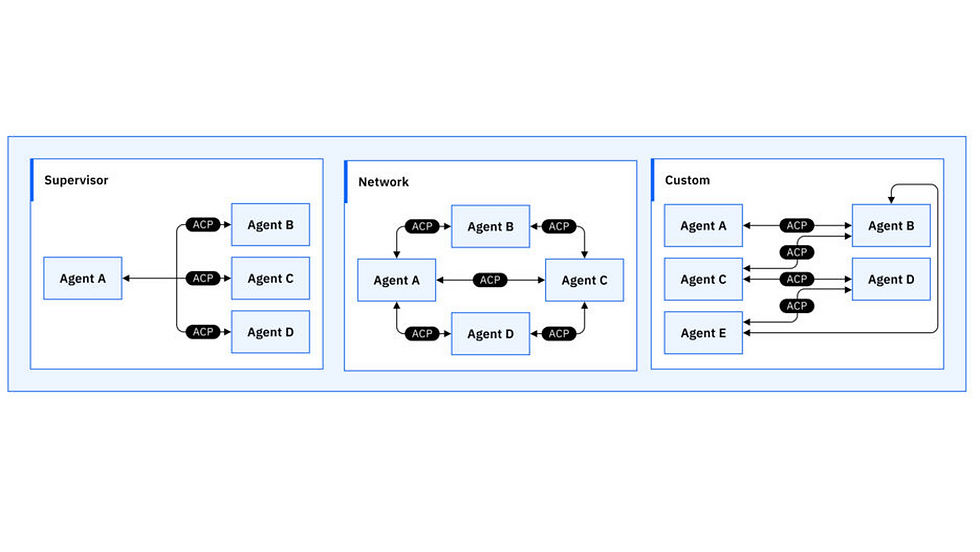
In essence, ACP ensures that when one agent says “I need data from you”, the receiving agent knows exactly what is being asked, how to respond, and in what context.
Why ACP Matters in Modern AI
With the rapid adoption of AI agents in business, manufacturing, customer support, and autonomous systems, inter-agent communication is no longer an afterthought — it’s a core design requirement.
Without ACP:
Agents may misinterpret messages.
Decision-making becomes inconsistent.
Collaboration efficiency drops.
System scaling becomes chaotic.
With ACP:
Consistency — all agents speak the same “language.”
Scalability — new agents can join without rewriting communication logic.
Efficiency — reduced message errors and misunderstandings.
Interoperability — agents from different developers can work together.
How ACP Works
At its core, ACP operates through structured communication acts similar to speech acts in human language.
1. Message Structure
An ACP message typically includes:
Performative — The intent (e.g., request, inform, confirm, propose).
Content — The information or command.
Ontology — The shared knowledge base or vocabulary.
Protocol — The sequence or type of conversation.
Example:
Performative: RequestContent: “Send sales forecast for Q4.”Ontology: Business KPI Terms v1.2Protocol: Data-sharing sequence

2. Common Protocol Patterns
ACP supports several interaction protocols such as:
Request-Response — One agent asks, another answers.
Contract Net Protocol — One agent announces a task, others bid to execute it.
Negotiation Protocols — Agents discuss terms until agreement is reached.
Publish-Subscribe — Agents broadcast updates to interested peers.
Applications of ACP
1. AI-Driven Business Workflows
Multiple AI agents — handling analytics, reporting, compliance, and customer engagement — can coordinate seamlessly.
2. Autonomous Systems
From drones to self-driving fleets, ACP ensures collaborative decision-making in real time.
3. Multi-Agent Research Environments
Simulation-based studies on market behaviors, ecosystem modeling, and resource optimization benefit from standardized communication.
4. Customer Service Bots
ACP allows tiered AI agents to escalate complex queries while keeping full context intact.
ACP in the Context of AdoSolve
At AdoSolve, ACP isn’t just theory — it’s an enabler.We leverage protocols like ACP to:
Build multi-agent ecosystems for clients.
Optimize agent collaboration in automation pipelines.
Ensure cost-effective and context-aware communication between LLM-powered agents.
This results in faster decision-making, fewer errors, and better scalability for enterprise AI deployments.
Challenges & Future of ACP
Challenges
Ontology Alignment — Agents need a shared vocabulary.
Security & Trust — Verifying the authenticity of agent messages.
Dynamic Adaptation — Protocols must evolve as agents learn new skills.
Future Outlook
ACP will become more adaptive, incorporating machine learning to optimize communication patterns, detect misunderstandings in real time, and dynamically restructure agent networks for better efficiency.
Conclusion
In the AI ecosystem, ACP is the grammar and syntax of agent collaboration. Without it, intelligent agents risk becoming isolated silos. With it, they can coordinate, negotiate, and achieve goals together — faster and smarter.
For businesses aiming to deploy scalable, efficient, and cost-conscious AI solutions, ACP is not just an option — it’s a strategic necessity.


Comments